
When shopping for sunglasses, understanding the difference between UV protection and polarized lenses is key. Many people assume they’re the same, but they serve completely different purposes. Here’s the quick breakdown:
- UV Protection: Shields your eyes from harmful UVA and UVB rays, which can lead to long-term eye damage like cataracts and macular degeneration. Look for labels like "UV400" or "100% UV protection."
- Polarized Lenses: Reduces glare from reflective surfaces like water, snow, or roads, improving clarity and comfort. However, polarization does not block UV rays.
Key takeaway: UV protection is crucial for eye health, while polarization enhances visual comfort. For the best results, choose sunglasses that combine both features.
Quick Comparison
| Feature | UV Protection Lenses | Polarized Lenses |
|---|---|---|
| Primary Function | Blocks harmful UVA/UVB rays | Reduces glare from reflective light |
| Main Benefit | Prevents long-term eye damage | Improves clarity and reduces strain |
| Lens Type | Clear or tinted | Always tinted |
| Best Use | Year-round eye safety | High-glare activities like driving or boating |
| Screen Visibility | No impact | May distort LCD/LED screens |
To protect your eyes effectively, always confirm your sunglasses provide 100% UV protection. Polarization adds comfort but doesn’t replace UV defense. Look for both features in one pair for optimal protection and performance.
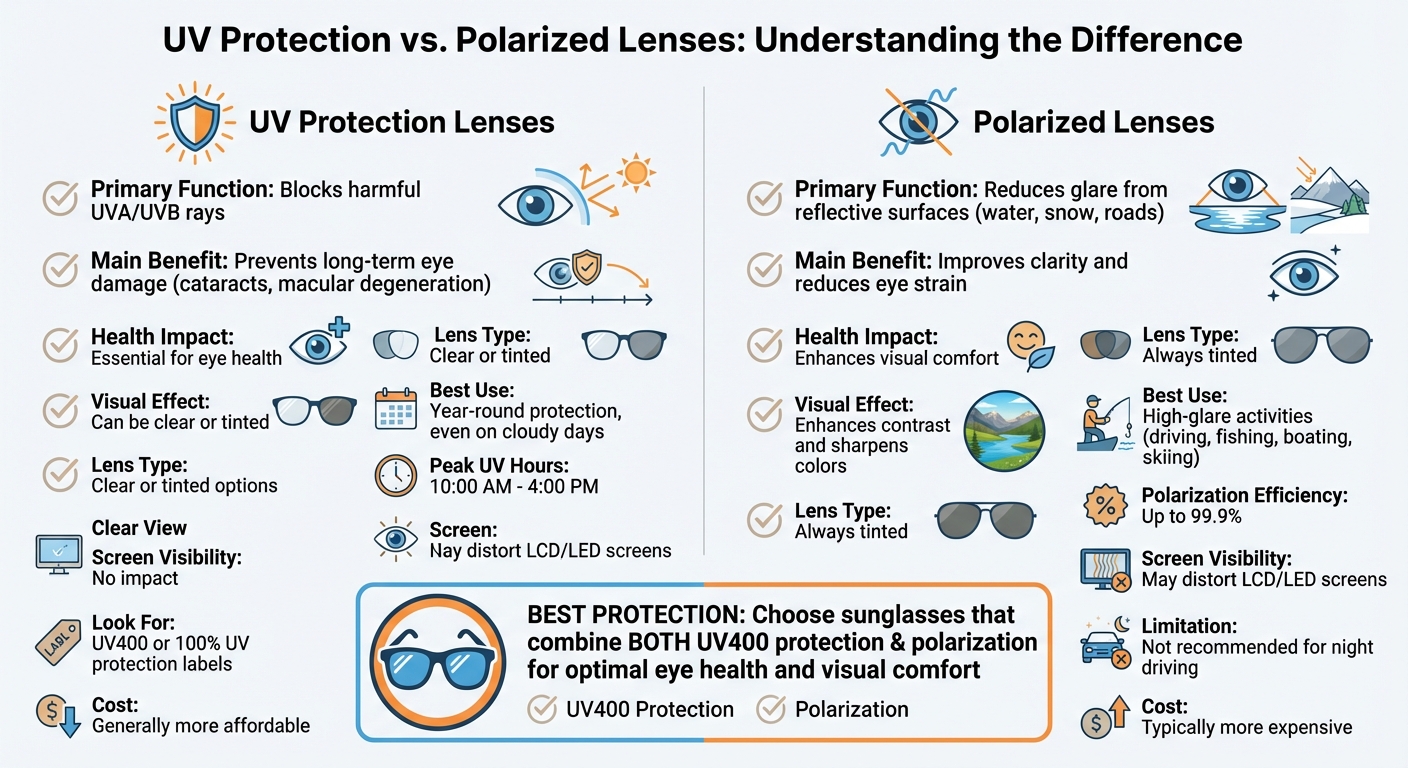
UV Protection vs Polarized Lenses: Key Differences and Benefits
Polarized vs UV Protection – Choosing the Right Sunglasses
Understanding UV Protection
UV-blocking lenses are designed to absorb or reflect harmful UVA and UVB rays, thanks to specialized coatings or materials like polycarbonate or Trivex, which naturally filter ultraviolet light. To ensure maximum protection, look for lenses labeled "UV400", as they block wavelengths up to 400 nanometers, effectively shielding your eyes from nearly 100% of UVA and UVB radiation.
It’s important to note that lens darkness doesn’t automatically equate to UV protection. A clear lens with the right coating can offer excellent defense against UV rays, while dark lenses without proper UV treatment can leave your eyes vulnerable. For sunglasses to meet legal standards as "UV sunglasses", they must block at least 75% of UV rays. This makes labels like "100% UV protection" or "UV400" critical when choosing protective eyewear.
UVA rays, which are far more common than UVB rays, penetrate deeper into the skin and eyes, contributing to premature aging. In contrast, UVB rays are the primary culprits behind sunburns and conditions like photokeratitis, with their intensity peaking between 10:00 AM and 4:00 PM. These protective properties are key to preventing long-term damage and maintaining eye health.
Health Benefits of UV Protection
Wearing sunglasses with 100% UV protection significantly lowers the risk of developing serious eye conditions. For example, cataracts, a condition where the eye’s natural lens becomes cloudy, are strongly linked to prolonged UV exposure. Paul Kim from Stoggles emphasizes this point:
"Staying in the sun without UV protection can cause cataracts to form, so don’t fool yourself into thinking you can’t have them by the time you’re thirty".
Another major concern is macular degeneration, which affects the retina and leads to central vision loss. This condition is irreversible, making UV protection a vital preventive measure.
Short-term UV exposure can result in photokeratitis, a painful condition often described as "sunburn of the eye." Dr. Chris Erwin, an optometrist at Cleveland Clinic, explains:
"It’s possible to develop keratitis, which is like sunburn on the eye".
Symptoms of photokeratitis include pain, redness, and sensitivity to light. UV protection also helps reduce the risk of pterygium, commonly referred to as "surfer’s eye." This condition involves permanent, wedge-shaped growths on the eye’s surface, often caused by UV rays reflecting off water or snow. Additionally, the delicate skin around the eyelids is highly susceptible to UV-induced skin cancers, such as basal and squamous cell carcinoma. Understanding these risks underscores the importance of protecting your eyes year-round.
When You Need UV Protection
UV protection isn’t just for sunny beach days – it’s essential throughout the year, even on cloudy days. UVA rays can penetrate cloud cover, making protective eyewear a necessity regardless of the weather. If you’re at a higher altitude, UV exposure increases, putting you at greater risk for conditions like corneal sunburn (UV keratitis). Reflective surfaces such as water, sand, and snow further intensify UV exposure, so activities like skiing, boating, or relaxing at the beach call for extra caution.
The hours between 10:00 AM and 4:00 PM are when UVB rays are strongest, making UV-blocking sunglasses particularly important during this time. If you’re unsure whether your sunglasses provide adequate protection, an eye-care professional can test their UV-blocking capabilities using a photometer. For added defense, opt for wraparound or oversized frames to shield your eyes and the surrounding skin from UV rays entering from the sides or top.
Understanding Polarized Lenses
Polarized lenses use a specialized chemical filter – usually a polyvinyl alcohol film – designed to align its molecules in a vertical pattern. When light reflects off flat surfaces like water, roads, or snow, it travels in horizontal waves, creating intense glare. The vertical filter blocks these horizontal waves, allowing only vertical light to pass through.
"Horizontal waves, which are too wide to pass through, smack into the ‘fence posts’ and bounce off." – William McCleary, Writer, Knockaround
This filtering process is what gives polarized lenses their unique ability to reduce glare and enhance visual clarity.
By cutting out reflected glare, these lenses sharpen your vision and improve contrast. Colors appear richer, depth perception becomes more defined, and details that might otherwise be washed out by glare come into focus. High-quality polarized lenses can achieve a polarization efficiency of up to 99.9%, nearly eliminating glare entirely. Some advanced lenses even filter specific wavelengths, such as harsh yellow light at 580 nanometers, to make red, green, and blue tones stand out more vividly.
Another major benefit is reduced eye strain. Without the constant need to squint against glare, your eyes experience far less fatigue during outdoor activities. However, it’s important to remember that polarization enhances comfort and visibility but doesn’t replace UV protection, which is essential for safeguarding your eye health.
Benefits of Polarized Lenses
The technology behind polarized lenses offers practical advantages, especially for outdoor activities. By eliminating glare from horizontal surfaces, these lenses make outdoor experiences more comfortable and safer. Blocking reflected light reduces the need for squinting, which is your body’s natural but tiring response to bright conditions.
"Wearing polarized glasses minimizes glare, reduces eye strain, and can help you make out details more clearly." – Christina Frank, Health Writer, Harvard Health Publishing
Polarized lenses also enhance contrast and depth perception, delivering sharper image quality and more vibrant colors. This clarity can be crucial for safety, as it reduces glare-induced blind spots and improves reaction times in activities like driving or boating.
Research from Johns Hopkins University highlights the risks of prolonged exposure to reflected light, noting that fishermen on the Chesapeake Bay faced a significantly higher chance of developing macular degeneration. To maximize protection, consider larger or wraparound frames that block unfiltered light from entering through the sides or top.
Best Uses for Polarized Lenses
Understanding how polarized lenses improve visual performance can help you choose the right eyewear for specific activities. These lenses are particularly effective in environments where light reflects off flat surfaces. For water-based activities like fishing, boating, kayaking, or surfing, they cut through surface reflections, allowing you to see beneath the water’s surface. They’re also excellent for daytime driving, as they reduce glare from the road and vehicle surfaces. Golfers appreciate the improved contrast on greens, while snow sports enthusiasts benefit from reduced glare on bright, snowy slopes. However, caution is needed in snowy conditions, as polarized lenses can make it harder to distinguish between harmless snow and dangerous black ice.
That said, there are situations where polarized lenses aren’t ideal. They’re not recommended for night driving because they reduce the amount of light reaching your eyes, which can impair vision in low-light settings. Additionally, the polarizing filter can interfere with viewing LCD screens, such as those on car dashboards, GPS devices, ATMs, or smartphones, causing them to appear distorted or dark.
UV Protection vs. Polarized Lenses: Main Differences
UV protection and polarized lenses serve different purposes when it comes to eye safety and comfort. UV protection works like sunscreen for your eyes, shielding them from harmful UVA and UVB rays that can lead to long-term damage like cataracts or macular degeneration. On the other hand, polarized lenses are designed to cut glare by filtering out horizontal light, which reduces eye strain and makes your surroundings appear clearer.
The main distinction is their focus: UV protection is crucial for safeguarding your eye health over time, while polarization enhances visual clarity and comfort. Glasses can offer just UV protection (such as clear prescription lenses with a UV coating) or only polarization. However, many experts suggest combining both features for the best results in eye care.
UV lenses can be either clear or tinted, and their primary role is to block harmful rays without addressing glare. Polarized lenses, which are always tinted, go a step further by improving contrast and color perception, making your view sharper and more vibrant. That said, polarized lenses have a downside – they can make LCD screens, like those on car dashboards or smartphones, appear dim or distorted.
Here’s a quick comparison to highlight the differences:
Comparison Table
| Feature | UV Protection Lenses | Polarized Lenses |
|---|---|---|
| Primary Function | Blocks harmful UVA/UVB rays | Filters horizontal light to reduce glare |
| Main Benefit | Protects against eye damage like cataracts and macular degeneration | Reduces glare and improves visual clarity |
| Health Impact | Essential for long-term eye health | Focused on immediate visual comfort |
| Visual Effect | Can be clear or tinted; does not affect glare | Enhances contrast and sharpens colors |
| Best Use Case | Suitable for any outdoor activity, even on cloudy days | Ideal for high-glare scenarios like driving, fishing, or skiing |
| Screen Visibility | No impact on screens | May dim or distort LCD/LED displays |
| Limitation | Does not address glare from surfaces like water or roads | Not ideal for night driving or detailed digital work |
| Cost | Generally more affordable | Typically more expensive due to the advanced technology involved |
sbb-itb-246add9
Using UV Protection and Polarized Lenses Together
Good news: you don’t need to choose between UV protection and polarization – many sunglasses offer both features in one pair. This combination shields your eyes from harmful UV rays while reducing glare, making your outdoor experience more comfortable. When shopping for sunglasses, it’s important to confirm that both features are present.
Polarization and UV protection are separate technologies, so they must be intentionally combined. Proper labeling is critical. As Christina Frank from Harvard Health Publishing advises:
"Check the label on polarized sunglasses to make sure they provide adequate UV protection".
When choosing sunglasses with dual protection, lens material is a key factor. Polycarbonate and trivex lenses are naturally UV-blocking and more durable than standard plastic, making them great for outdoor sports and active lifestyles. Frame design matters, too – oversized or wraparound frames offer better coverage by blocking UV rays and glare from sneaking in at the sides, top, or bottom.
If you already own polarized sunglasses but aren’t sure about their UV protection, it’s a good idea to have them tested. Most opticians can check this quickly with a UV light meter, often at no cost. Keep in mind that UV protection can diminish over time, so it’s worth having your sunglasses tested every couple of years to ensure they’re still doing their job.
For those in the Cheyenne area, local resources like Cheyenne Eye Clinic and Surgery Center can help. They provide optical evaluations and eye care services to ensure your sunglasses are offering the best possible protection.
How to Choose the Right Eyewear
When it comes to selecting eyewear, prioritizing both protection and practicality is key. Here’s how to find a pair that checks all the boxes.
Start with UV protection. Your sunglasses should block 99–100% of UV rays – look for labels like "UV400" or "100% UV protection". Dr. Bryce St. Clair from Johns Hopkins Medicine emphasizes the importance of this feature: "Look for sunglasses with 95%–100% UV protection or a ‘UV 400’ sticker". Remember, it’s the UV coating that matters, not how dark the lenses are.
Next, think about whether polarized lenses fit your lifestyle. Polarized lenses are excellent for cutting glare, especially in situations like driving, boating, or snowy conditions. Dr. Chris Erwin from Cleveland Clinic highlights their effectiveness: "Polarized lenses do a fantastic job of removing glare while driving and boating, making the world look crisper and clearer than sunglasses alone". However, if you frequently use devices with LCD screens – like smartphones, GPS systems, or digital dashboards – polarization might not be ideal, as it can make these screens appear darker or distorted.
Frame style and lens material also play a big role. Choose frames with ample coverage, like wrap-around designs, to block stray UV rays from all angles. If you’re into high-impact activities like sports, go for polycarbonate lenses. These lenses are shatterproof and inherently block UV rays without needing additional coatings.
Finally, consider environmental factors and timing. UV rays are strongest between 10:00 AM and 4:00 PM, and they can even penetrate through clouds. If you have light-colored eyes, you may be more sensitive and need extra protection.
Don’t forget to replace your sunglasses every two years, as their UV protection can degrade over time. If you’re unsure whether your current sunglasses are still effective, places like Cheyenne Eye Clinic and Surgery Center offer testing to check their UV-blocking capabilities.
Conclusion
Protecting your eyes from harmful UV rays is crucial to preventing serious conditions like cataracts, macular degeneration, and ocular cancers. At the same time, polarized lenses are excellent for cutting down glare, making them ideal for activities like driving, fishing, or skiing.
For the best of both worlds, look for sunglasses that combine UV400 protection with polarization. This pairing not only shields your eyes from damaging radiation but also reduces glare in bright environments. Remember, polarization alone doesn’t block UV rays, so always check for labels like "100% UV protection" or "UV400" to ensure your eyes are fully protected.
If you’re unsure about your sunglasses or need help finding the right pair, the team at Cheyenne Eye Clinic and Surgery Center can assist. They offer quick UV protection tests – taking less than a minute – and can recommend eyewear tailored to your specific needs and lifestyle.
FAQs
Do polarized lenses protect against UV rays?
No, polarized lenses alone don’t provide protection from harmful UV rays. Their primary function is to reduce glare by filtering reflected light, but they need a UV-blocking coating to effectively shield your eyes from UV damage.
To fully protect your eyes, choose sunglasses that offer both polarized lenses and 100% UV protection. This combination not only improves visibility in bright conditions but also helps guard against long-term risks like cataracts and macular degeneration.
Why is protecting your eyes from UV rays important?
Protecting your eyes from UV rays is crucial, as extended exposure to UVA and UVB rays can lead to serious eye conditions. These include cataracts, macular degeneration, and even eyelid cancers. UV damage can also harm the cornea and retina, potentially causing long-term vision issues or even permanent loss of vision.
Choosing sunglasses with 100% UV protection is an easy and effective way to safeguard your eyes and support healthy vision. And don’t forget – UV rays don’t take a break during cloudy weather or colder months, so keeping your eyes protected should be a year-round habit.
How can I make sure my sunglasses have both UV protection and polarized lenses?
To make sure your sunglasses provide 100% UV protection and include polarized lenses, here’s what you need to do:
- Check for a UV-400 or 100% UV label. This ensures the lenses block all UVA and UVB rays, shielding your eyes from harmful ultraviolet light.
- Look for a polarized label. Polarized lenses are typically marked with a label or logo, often featuring a "P" symbol.
- Test for polarization. Hold the sunglasses in front of a digital screen, like your phone or laptop. Rotate the lenses – if the screen darkens or becomes invisible at certain angles, the lenses are polarized.
- Ask the retailer or review product details. Trustworthy sellers will clearly state if the sunglasses offer both UV protection and polarization.
If you’d like expert confirmation, consider visiting Cheyenne Eye Clinic and Surgery Center. Their eye care professionals can verify whether the lenses meet UV-400 standards and include a polarizing filter. UV protection is crucial all year long, while polarization is especially helpful for cutting glare during activities like driving or outdoor sports.