
If you’re preparing for cataract surgery, choosing the right intraocular lens (IOL) is a key decision. IOLs replace your natural lens to restore vision affected by cataracts and can also correct issues like nearsightedness, farsightedness, and astigmatism. Here’s a quick breakdown:
- Standard Monofocal IOLs: Offer sharp vision at a single distance (usually far). You’ll likely need glasses for reading or close-up tasks. These are typically covered by insurance.
- Premium IOLs: Provide vision at multiple distances (near, intermediate, far) and can address astigmatism. They reduce reliance on glasses but come with higher costs (up to $7,000 per eye) and potential side effects like halos or glare.
Your choice depends on your lifestyle, vision needs, and budget. Standard lenses are reliable and cost-effective, while premium options offer versatility but require a financial investment. Consult your eye specialist to determine the best fit for you.
Every Cataract Lens Explained in 11 Minutes
sbb-itb-246add9
What Are Standard Monofocal IOLs?
Standard monofocal intraocular lenses (IOLs) are artificial lenses implanted during cataract surgery to replace your natural lens. Unlike premium lenses, which offer multiple focal points, monofocal IOLs are designed to provide clear vision at a single distance – usually optimized for far vision. This makes them ideal for tasks like driving or watching TV.
Most people opt for distance-focused monofocal IOLs and rely on reading glasses for close-up activities like reading or using a smartphone. One of the biggest advantages of these lenses is their ability to deliver sharp, high-contrast vision at the chosen focal point. Plus, they’re widely accessible since most insurance plans cover their cost, unlike premium lenses that often come with additional expenses.
Let’s explore what makes these lenses unique and who they’re best suited for.
Features of Standard Monofocal IOLs
Monofocal IOLs correct refractive errors, such as nearsightedness or farsightedness, by focusing light precisely on the retina. Unlike premium lenses, which spread their optical power across multiple distances, monofocal lenses concentrate all their focus on a single distance – typically starting at around 4–5 feet and extending farther.
"You cannot maximize image sharpness and depth of focus at the same time. A monofocal lens (standard IOL) prioritizes clarity (crisp vision at a single focal point)."
- Dr. Robert Burke, Optometrist, Calgary Vision Centre
This design ensures maximum clarity and contrast at the selected distance, making monofocal lenses particularly effective for activities requiring sharp distance vision, like night driving. While premium lenses may offer a broader range of vision, they sometimes come with trade-offs, such as halos or slightly reduced sharpness. Monofocal lenses, on the other hand, deliver the crispest possible vision at their set focal point.
However, these lenses do have limitations. You’ll still need glasses for near and intermediate tasks, such as reading or working on a computer. Some patients consider monovision as an alternative, where one eye is fitted with a distance-focused lens and the other with a near-focused lens, to reduce dependency on glasses.
Best Candidates for Standard IOLs
Standard monofocal IOLs are a great fit for those who value clear distance vision and don’t mind wearing glasses for close-up tasks. They’re also an excellent choice for individuals looking for a budget-friendly option, as insurance typically covers their cost.
Patients with certain pre-existing eye conditions – such as macular degeneration, diabetic retinopathy, glaucoma, or corneal scars – may find monofocal lenses particularly beneficial. These lenses provide simpler, more reliable optics, which can be an advantage in cases where more complex lenses might not perform as well. And if vision adjustments are needed after surgery, glasses or LASIK corrections are generally straightforward with monofocal lenses.
Selecting the right IOL depends on your vision goals and lifestyle. While monofocal lenses are a reliable choice, exploring premium options can help you make the most informed decision.
What Are Premium IOLs?
Premium intraocular lenses (IOLs) are advanced artificial lenses designed to do more than standard monofocal IOLs. While monofocal lenses focus on a single distance, premium IOLs provide vision at multiple distances – near, intermediate, and far – and can also address issues like astigmatism and presbyopia (the age-related difficulty in focusing on close objects). The main difference lies in their functionality: monofocal lenses excel in clarity at one focal point, while premium IOLs spread their optical power across a broader range. This trade-off offers greater versatility but may slightly compromise sharpness at any one distance.
Research shows that over 70% of patients who opt for premium IOLs would choose them again, and more than 80% report rarely or never needing glasses after surgery. The market for these lenses is expected to surpass $6.5 billion by 2027. This surge is fueled by an aging population seeking more visual independence than standard distance correction can provide. Let’s dive into the benefits these lenses offer, along with some potential drawbacks.
Benefits of Premium IOLs
One of the biggest perks of premium IOLs is reduced reliance on glasses for everyday activities. Whether it’s reading a menu, scrolling through your phone, working on a computer, or driving at night, these lenses allow you to perform a variety of tasks without constantly switching between different pairs of glasses – a major plus for active lifestyles.
"Premium intraocular lenses don’t just fix cloudy vision. They give you the ability to read, drive, and live without reaching for glasses."
Different types of premium IOLs cater to specific needs:
- Multifocal and trifocal IOLs: These lenses use diffractive rings to create focal points for both near and far vision, offering high levels of independence from glasses.
- Extended Depth of Focus (EDOF) lenses: These provide a smooth range of vision, making them ideal for tasks like computer work while minimizing night-time visual disruptions.
- Toric IOLs: Specifically designed to correct corneal astigmatism, which standard lenses cannot address.
Nearly 90% of patients report satisfaction with their vision after receiving premium IOLs. For many, the convenience of not needing reading glasses or juggling multiple pairs outweighs the higher cost. However, there are some factors to consider before making a decision.
Drawbacks of Premium IOLs
Premium IOLs aren’t suitable for everyone. The most notable drawback is cost. While standard monofocal lenses are often covered by insurance or Medicare, premium IOLs are considered an upgrade, requiring out-of-pocket expenses ranging from $1,500 to $3,000 per eye – and in some cases, up to $7,000 per eye.
In addition to cost, some patients experience visual side effects. Multifocal lenses, for instance, can cause halos or glare around lights at night. EDOF lenses generally produce fewer of these issues, but they still involve a trade-off between a broader range of vision and absolute sharpness.
Another consideration is the condition of the retina. Premium IOLs work best with a healthy retina, so patients with conditions like macular degeneration, diabetic retinopathy, or advanced glaucoma may not benefit as much. Additionally, some premium lenses require a period of "neuroadaptation", during which the brain learns to process the multiple images created by the new lens.
Finally, fine-tuning vision post-surgery can be more challenging with premium IOLs. While adjustments with glasses or LASIK are relatively straightforward for monofocal lenses, enhancements after premium IOL implantation are more complex. This makes a thorough pre-surgical evaluation of your eye health and visual goals a critical step before choosing a premium lens.
Types of Premium IOLs
Premium IOLs (intraocular lenses) are tailored to address different vision challenges, offering options to match individual lifestyles and visual preferences. Below, we explore the main types of premium IOLs and their unique features.
Multifocal IOLs
Multifocal lenses are designed with diffractive zones that create distinct focal points for near, intermediate, and far vision. This technology allows the brain to seamlessly switch focus for tasks like reading, working on a computer, or driving. Many people find they can significantly reduce their reliance on glasses after receiving these lenses. For instance, the Alcon PanOptix is a favorite among surgeons for patients aiming for glasses-free vision. However, some individuals may experience halos or glare around lights at night, especially in dim conditions. To address this, some surgeons opt for a "blended" strategy, using an Extended Depth of Focus (EDOF) lens in the dominant eye and a trifocal lens like PanOptix in the non-dominant eye, enhancing the overall range of vision.
If you’re looking for a smoother transition across vision ranges without distinct focal zones, EDOF lenses might be a better fit.
Extended Depth of Focus (EDOF) IOLs
EDOF lenses provide a single elongated focal point, offering a continuous range of clear vision from intermediate to distance. Popular options like the TECNIS Symfony and Alcon Vivity stand out, with the Vivity lens being selected by 39.7% of surgeons. These lenses are particularly well-suited for activities like computer work and viewing a car dashboard, while also reducing night-vision issues often associated with multifocal lenses. However, they aren’t perfect for every situation – reading glasses may still be needed for very small print. Most patients find the clarity at intermediate and distance ranges to be a fair trade-off.
For those with astigmatism, there’s a specific lens option designed to address this condition.
Toric IOLs for Astigmatism
Toric lenses are crafted to correct astigmatism, which occurs when the cornea has an irregular shape, leading to blurry or distorted vision across all distances. Unlike standard monofocal or other premium lenses, toric IOLs align light more precisely on the retina, correcting the distortion. These lenses are available in both monofocal and multifocal versions, combining the benefits of premium vision correction with astigmatism treatment. Precise surgical alignment is crucial for their effectiveness, making them a key option for patients who want to reduce their dependence on glasses while addressing astigmatism.
Standard vs. Premium IOLs: Side-by-Side Comparison
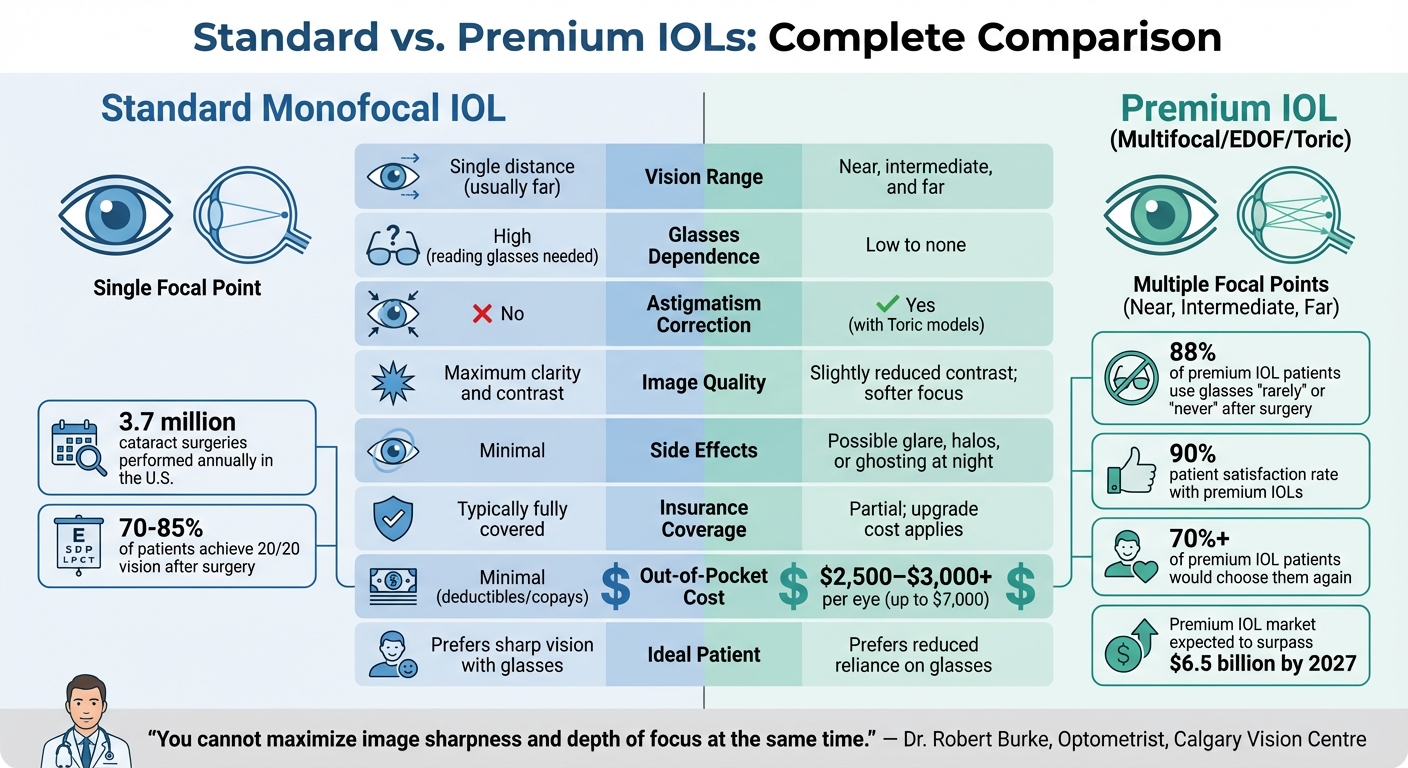
Standard vs Premium IOLs: Complete Comparison Guide
Deciding between standard and premium intraocular lenses (IOLs) comes down to prioritizing either sharpness at a single distance or a broader range of vision. Standard monofocal lenses are designed to offer clear vision at one specific distance – typically far – requiring reading glasses for tasks like reading or using a smartphone. On the other hand, premium lenses, such as multifocal or extended depth of focus (EDOF) options, aim to provide clarity across near, intermediate, and far distances. However, they may slightly compromise contrast sensitivity, particularly in low-light conditions.
"You cannot maximize image sharpness and depth of focus at the same time."
- Dr. Robert Burke, Optometrist, Calgary Vision Centre
This trade-off affects both the visual experience and the financial investment. Standard IOLs are often fully covered by insurance, leaving patients responsible only for deductibles or copays. Premium IOLs, however, come with an additional out-of-pocket expense – typically around $2,500 per eye, with total costs sometimes reaching up to $7,000 per eye. Patients opting for premium lenses may also experience a neuroadaptation period, during which the brain adjusts to processing multiple focal points. This adjustment can take time and varies by individual.
Here’s a side-by-side comparison to help clarify the distinctions:
Comparison Table: Standard and Premium IOLs
| Factor | Standard Monofocal IOL | Premium IOL (Multifocal/EDOF/Toric) |
|---|---|---|
| Vision Range | Single distance (usually far) | Near, intermediate, and far |
| Glasses Dependence | High (reading glasses needed) | Low to none |
| Astigmatism Correction | No | Yes (with Toric models) |
| Image Quality | Maximum clarity and contrast | Slightly reduced contrast; softer focus |
| Side Effects | Minimal | Possible glare, halos, or ghosting at night |
| Insurance Coverage | Typically fully covered | Partial; upgrade cost applies |
| Out-of-Pocket Cost | Minimal (deductibles/copays) | Around $2,500–$3,000+ per eye |
| Ideal Patient | Prefers sharp vision with glasses | Prefers reduced reliance on glasses |
With over 3.7 million cataract surgeries performed annually in the U.S., understanding these differences is essential for selecting the option that best fits your lifestyle and visual priorities.
Cost Considerations for IOL Options
When it comes to choosing intraocular lenses (IOLs), understanding the costs is just as important as evaluating their performance and the quality of vision they provide. Financial factors can heavily influence the decision between standard and premium IOL options.
Insurance Coverage and Out-of-Pocket Costs
For standard monofocal IOLs, insurance typically covers the procedure, leaving you responsible for deductibles and copays.
On the other hand, premium IOLs – such as multifocal, extended depth of focus (EDOF), or toric lenses – are considered elective upgrades. While insurance covers the base procedure, you’ll need to pay an additional $1,500 to $3,000 per eye, with some cases reaching as high as $7,000 per eye.
It’s a good idea to ask for a detailed cost breakdown during your consultation. Costs can vary depending on the specific technology used. For example, a toric lens designed to correct astigmatism may have a different price point than a multifocal lens that provides vision at multiple distances. Also, inquire about payment plans or financing options that might make these upgrades more manageable.
Long-Term Value of Premium IOLs
Although premium IOLs come with a higher upfront cost, they deliver long-term benefits that can outweigh the initial expense. These lenses are designed to last a lifetime, and many patients find that they significantly reduce or even eliminate the need for glasses or contact lenses. For instance, about 88% of patients with multifocal or EDOF lenses reported using glasses "rarely" or "never" after their surgery. This reduction in dependency can lead to considerable savings on recurring costs like updated prescriptions, frames, and lenses over the years.
In fact, over 70% of patients who opted for premium lenses said they would make the same choice again, even when factoring in the out-of-pocket costs.
"Premium IOLs are a one-time investment in vision that lasts a lifetime"
- Eye Associates of South Texas
Additionally, the premium IOL market is expected to surpass $6.5 billion by 2027, driven by active adults who see cataract surgery as a unique opportunity to permanently improve their vision.
How to Choose the Right IOL
Selecting the right intraocular lens (IOL) involves considering your lifestyle, vision needs, and overall eye health. Start by reflecting on your daily activities. For those who spend a lot of time on near or intermediate tasks, such as reading or working on a computer, multifocal lenses might be a great option. On the other hand, if you enjoy outdoor activities like golfing, frequently drive long distances, or need sharp distance vision, a standard lens or an extended depth of focus (EDOF) lens might suit you better. However, night drivers should be cautious – some premium lenses can cause halos or ghosting in low-light settings.
Your eye health is another key factor. Premium IOLs often work best when the retina is in good condition. If you have conditions like macular degeneration or diabetic retinopathy, your surgeon may recommend a standard monofocal lens instead. For those with astigmatism, a toric IOL might be necessary to correct the irregular shape of the cornea.
When choosing an IOL, it’s also important to weigh clarity against range. As Dr. Robert Burke from Calgary Vision Center explains:
"You cannot maximize image sharpness and depth of focus at the same time" – Dr. Robert Burke, Optometrist, Calgary Vision Centre
This means you’ll need to decide whether you value complete independence from glasses or the sharpest possible vision at a specific distance.
Lastly, think about the potential for adjustments after surgery. If you opt for a standard IOL, it’s generally easier to correct any lingering vision issues with glasses or LASIK. In contrast, fine-tuning premium IOLs can be more complex and, in some cases, not feasible. This aspect is worth considering, especially when balancing long-term vision goals with upfront costs. Keep in mind that premium lenses may also require an adjustment period.
Discuss these considerations with your specialist at Cheyenne Eye Clinic and Surgery Center to find the best IOL for your needs and lifestyle.
Consultation Process at Cheyenne Eye Clinic and Surgery Center
At Cheyenne Eye Clinic and Surgery Center, your journey to selecting the right IOL starts with a personalized consultation tailored to your vision needs. The clinic’s board-certified doctors and skilled technicians take the time to understand how you use your eyes in daily life. Whether you spend hours driving at night, working on a computer, or enjoying hobbies like reading, they’ll assess your lifestyle to determine if a standard monofocal lens with sharp, high-contrast vision or a premium lens offering multi-distance clarity is the better fit for you. This initial assessment lays the groundwork for detailed discussions about your eye health and options.
The team also evaluates your eye health for conditions such as astigmatism or presbyopia, which might require specialized lenses like Toric or Multifocal IOLs. To help you make an informed decision, the clinic uses advanced high-resolution computer simulations. These tools allow you to see how different lens choices could impact your vision in real-world scenarios. Additionally, the consultation includes a thorough review of the financial aspects, ensuring complete transparency.
Financing options are discussed to help align your vision goals with your budget. While insurance typically covers the cost of standard IOLs as part of a medically necessary procedure, premium lens upgrades can cost up to about $7,000 per eye, depending on the technology involved. For those considering premium lenses, doctors also explain neuroadaptation – the adjustment period when your brain adapts to new visual inputs – and potential side effects like halos or ghosting in low-light conditions.
To make your visit as smooth as possible, come prepared with essential documents like your photo ID, insurance card, and payment method. As one of the clinic’s cataract specialists puts it:
"Everything we do is focused on you so you can focus on what matters."
With comprehensive, on-site services, the clinic ensures seamless care from your initial evaluation all the way through surgery.
Conclusion
Choosing between standard and premium IOLs is a decision that directly impacts your vision for the rest of your life. Standard monofocal lenses are designed to provide sharp vision at a single distance, typically for far vision, meaning you’ll likely still need reading glasses for close-up tasks. On the other hand, premium IOLs – such as multifocal, extended depth of focus (EDOF), and toric lenses – offer a wider range of vision, potentially reducing your reliance on glasses. However, these advanced lenses may come with some trade-offs, such as reduced contrast or sharpness in low-light settings.
This decision is significant and generally irreversible. While 70% to 85% of patients achieve 20/20 vision after surgery, the best lens for you ultimately depends on your unique lifestyle, eye health, and personal visual goals.
Cost is another key factor. Standard IOLs are often covered by insurance, while premium lenses can cost up to $7,000 per eye. Despite the higher price, nearly 90% of patients who opt for premium IOLs report satisfaction with their results, indicating that many find the long-term visual benefits worth the upfront expense.
To make the best choice for your vision, consider scheduling a consultation at Cheyenne Eye Clinic and Surgery Center. Their advanced diagnostic tools, high-resolution simulations, and open discussions about costs and outcomes can help you confidently decide on the lens that aligns with your lifestyle, budget, and vision needs.
FAQs
How long does it take to adjust to a premium IOL?
Adjusting to a premium IOL typically takes anywhere from a few days to six months. Most people find their vision stabilizes during this period, but in some cases, complete adaptation may not occur. If you notice ongoing challenges with your vision, it’s important to reach out to your eye care provider for advice and support.
Can I still get a premium IOL if I have macular degeneration or glaucoma?
Patients with macular degeneration or glaucoma might still qualify for premium intraocular lenses (IOLs), depending on their individual eye health. Some premium IOLs, like aspheric or toric lenses, can improve contrast sensitivity or address astigmatism in individuals with glaucoma. That said, macular degeneration could influence the overall visual results. It’s important to consult your eye care provider to explore the most suitable options for your specific condition.
What happens if I don’t like my vision after cataract surgery?
If you’re not satisfied with your vision after cataract surgery, it’s important to discuss your concerns with your eye care provider. They can explore solutions like prescription glasses, contact lenses, or even additional procedures to fine-tune your results. There are often ways to address these issues and help you see more clearly.