
A toric IOL can correct astigmatism during cataract surgery – but it doesn’t guarantee freedom from glasses. My main advice: ask whether your corneal measurements and vision goals make it a good fit. About 1.00 diopter (D) or more of regular corneal astigmatism is a common starting point, not a strict cutoff.
Here’s what I’d keep in mind:
- Lens choice matters. “Toric” means astigmatism correction, not near focus. Reading glasses are often needed with a distance-targeted monofocal lens.
- Accurate measurements and alignment matter. Dry eye can affect testing, and lens rotation can leave vision blurry.
- Recovery needs a plan. Follow drop instructions, arrange transportation, and keep follow-up visits. <u>Sudden vision loss or severe pain needs immediate medical attention.</u>
- Check costs before scheduling. Original Medicare usually covers cataract surgery and a standard lens, but you typically pay for the toric upgrade.
I’d weigh the choice around realistic vision goals, eye health, recovery needs, and a written cost estimate – not just the hope of fewer glasses.
Who Can Get a Toric IOL?
A toric IOL isn’t right for every cataract patient. You may be a candidate if a cataract interferes with your daily vision and you have about 1.00 diopter (D) or more of regular corneal astigmatism. That’s a guideline, not a cutoff. Regular astigmatism has two main meridians about 90 degrees apart.
Your eye health and vision goals also matter. Macular disease, glaucoma, or optic-nerve damage may limit how much your vision improves. Tell your surgeon which tasks matter most to you and how much you’d like to reduce your need for glasses.
Tests to Check Whether a Toric IOL Is Right for You
Your surgeon uses several tests to check whether a toric IOL fits your needs. Refraction measures your glasses prescription, including cylinder power and axis. Keratometry measures corneal curvature, and biometry measures eye dimensions to calculate lens power. Your glasses prescription is only one part of the decision.
Corneal topography maps the cornea’s front surface, while tomography also maps its back surface. These tests help identify irregular astigmatism, scars, or corneal disease that can make results less predictable. Tell your surgeon about any previous eye surgery, since it can affect measurements and planning.
Dry eye can distort measurements. Report burning, fluctuating vision, or a gritty feeling, and tell your surgeon if you wear contact lenses before measurements are finalized. Your surgeon may treat the eye surface and repeat measurements before choosing the lens power. Those measurements guide both lens choice and alignment.
sbb-itb-246add9
Benefits and Limits of Toric IOLs
Once you know you’re a candidate, it helps to understand what a toric lens can – and can’t – do.
A toric IOL corrects regular corneal astigmatism during cataract surgery and may improve distance vision without glasses. Results depend on lens alignment, healing, and any other eye conditions.
Toric describes astigmatism correction, not the range of focus. Toric lenses can be monofocal, multifocal, or extended-depth-of-focus. A monofocal toric lens focuses best at one distance. Multifocal and extended-depth-of-focus lenses may offer a broader range of focus, but they can cause glare, halos, or reduced contrast.
| Benefits | Limitations and considerations |
|---|---|
| Reduces the refractive effect of regular corneal astigmatism | Does not reliably correct every pattern, especially irregular astigmatism |
| May improve vision without glasses when distance is the target | Other eye conditions may limit vision |
| May reduce the need for distance glasses | Reading glasses are often still needed with monofocal toric lenses targeted for distance |
Even when astigmatism is well corrected, you may still need glasses for certain tasks.
Glasses After a Toric IOL
Whether you need glasses for reading or night driving depends on your lens type, target distance, and final prescription. A distance-targeted monofocal toric lens does not restore your eye’s natural ability to focus up close, so reading glasses are often still needed.
Residual astigmatism is astigmatism that remains after surgery. If your vision stays blurry, ask your surgeon to check your prescription, eye surface, and lens alignment before choosing a treatment. Glasses may be enough. If blur persists after your eye stabilizes, your surgeon may need to check for remaining refractive error or lens rotation.
What to Expect Before, During, and After Surgery
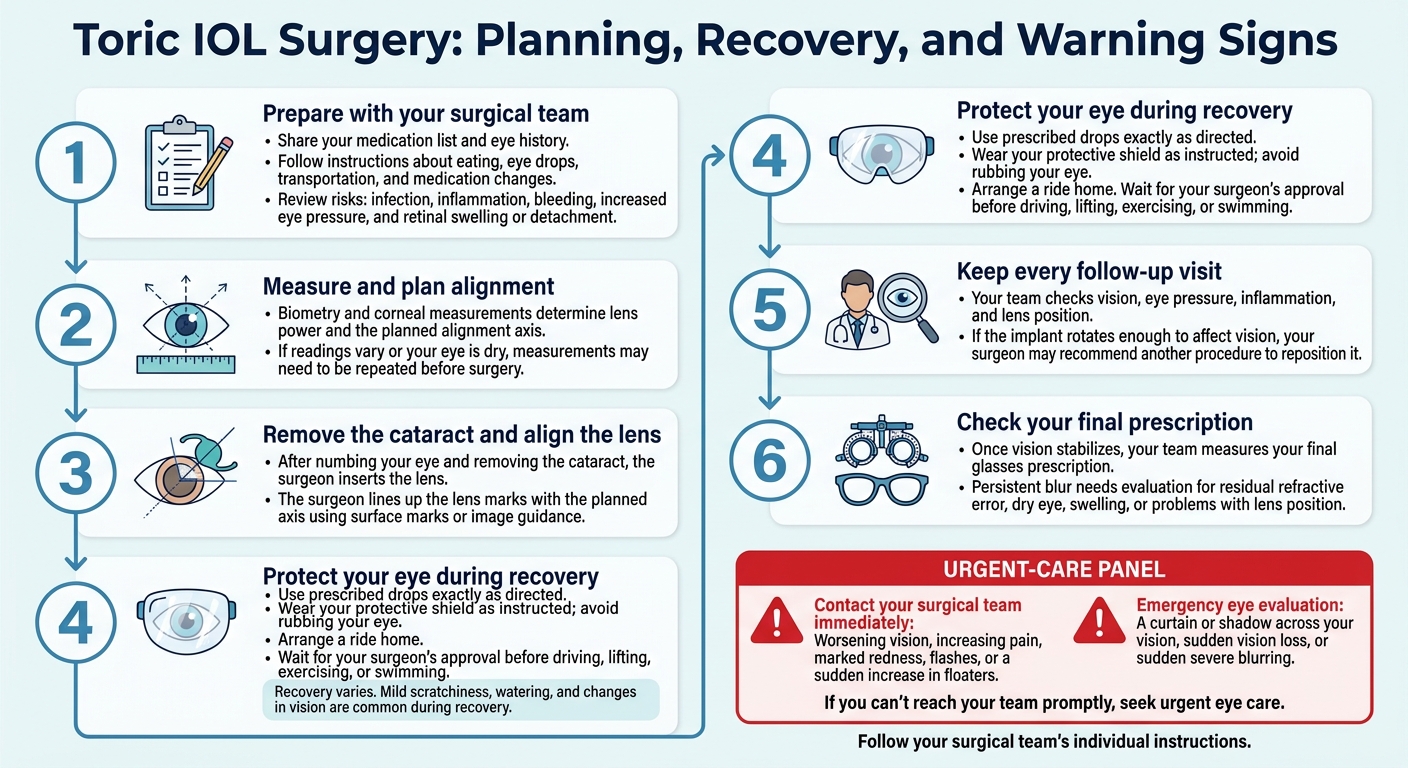
Toric IOL Surgery: Planning, Recovery, and Warning Signs
Toric IOL surgery follows the same steps as standard cataract surgery, with extra planning to align the lens. Share your medication list and eye history with your team. Follow their instructions about eating, eye drops, transportation, and any medication changes.
Before surgery, review the risks with your team, including infection, inflammation, bleeding, increased eye pressure, and retinal swelling or detachment.
Lens Selection and Alignment
Biometry and corneal measurements help determine lens power and the planned alignment axis. If the readings vary or your eye is dry, your team may need to repeat these measurements before surgery.
After numbing your eye and removing the cataract, the surgeon inserts the lens. They then line up its marks with the planned axis using surface marks or image guidance.
Recovery and Follow-Up Care
Use prescribed drops exactly as directed, wear your protective shield as instructed, and avoid rubbing your eye. Arrange a ride home. Wait for your surgeon’s approval before driving, lifting, exercising, or swimming.
Recovery varies from person to person. Mild scratchiness, watering, and changes in vision are common during recovery.
Keep every follow-up visit. Your team will check your vision, eye pressure, inflammation, and lens position. Once your vision stabilizes, they’ll measure your final glasses prescription. If the implant rotates enough to affect your vision, your surgeon may recommend another procedure to reposition it.
Symptoms That Need Urgent Care
Watch for signs of a complication. Contact your surgical team immediately if you notice worsening vision, increasing pain, marked redness, flashes, or a sudden increase in floaters.
A curtain or shadow across your vision, sudden vision loss, or sudden severe blurring requires emergency eye evaluation. If you can’t reach your team promptly, seek urgent eye care.
Blur that persists also needs evaluation. Your team will check for residual refractive error, dry eye, swelling, or problems with lens position.
What to Discuss at Your Cataract Evaluation
Use your cataract evaluation to check whether toric correction fits your eye measurements and vision goals. Ask which measurements will guide the lens choice and help ensure accurate correction. Discuss whether irregular astigmatism, corneal disease, severe dry eye, or contact lens wear could affect measurement accuracy or change which lens is right for you.
If a toric lens suits your eye, talk through your vision goals. Explain which tasks matter most to you: driving, reading, computer work, outdoor work, and recognizing faces. Ask what vision to expect at distance, midrange, and near – and when you may still need glasses.
Also, plan for recovery. Review transportation, help with eye drops, and any help you’ll need at home during the first 1–2 days.
Costs and Insurance Coverage
Once you’ve settled on a lens, review the full cost before surgery. Request an itemized written estimate before scheduling. It should separate covered services from out-of-pocket charges for the toric upgrade, extra testing, and follow-up care. Confirm whether the estimate covers one or both eyes, whether costs could change if surgery is delayed, and whether it includes later vision correction procedures or lens repositioning.
Original Medicare usually covers medically necessary cataract surgery and a standard IOL, but you typically pay for the toric upgrade yourself. Private insurance and Medicare Advantage coverage varies by plan. Before surgery, check with both your insurer and surgical facility about network status, prior authorization, deductibles, coinsurance, and your expected cost.
FAQs
Can I get a toric IOL after LASIK?
You may be a candidate for a toric IOL after LASIK. Since LASIK changes the shape of your cornea, you’ll need a thorough evaluation before surgery at Cheyenne Eye Clinic and Surgery Center.
Our specialists use advanced diagnostic tools to check your eye health and map your cornea. These measurements help them select the right lens and plan your surgery.
Schedule a consultation to discuss your vision history and goals.
How long does a toric IOL last?
Toric intraocular lenses are designed to last a lifetime. During cataract surgery, they replace your natural lens to permanently correct astigmatism and reduce your need for glasses or contact lenses.
While the lens stays in place for life, your brain usually needs time to get used to it. This adjustment, called neuroadaptation, can take anywhere from a few days to six months.
How soon would a rotated toric IOL need repositioning?
The provided information does not state when a rotated toric IOL should be repositioned. If vision problems persist after surgery or you think your lens may be misaligned, contact your eye care provider at Cheyenne Eye Clinic and Surgery Center. They can assess your vision and recommend the next steps.