
Using glaucoma eye drops correctly can help protect your vision and prevent further damage. Here are the key takeaways for effective application:
- Wash your hands before use to avoid infections.
- Keep the dropper tip clean to prevent contamination.
- Use only one drop per application – your eye can’t absorb more.
- Pull down your lower eyelid to create a pocket for the drop.
- Close your eyes gently and press the inner corner to keep the medication in place.
- Block tear ducts to stop the medication from draining away.
- Wait 5 minutes between different drops to ensure proper absorption.
- Stick to your schedule for consistent treatment.
- Set reminders to avoid missing doses.
- Store drops correctly at the recommended temperature.
These steps improve absorption, reduce side effects, and help you get the most out of your treatment. If you’re struggling with application or experiencing side effects, consult your doctor for personalized advice.
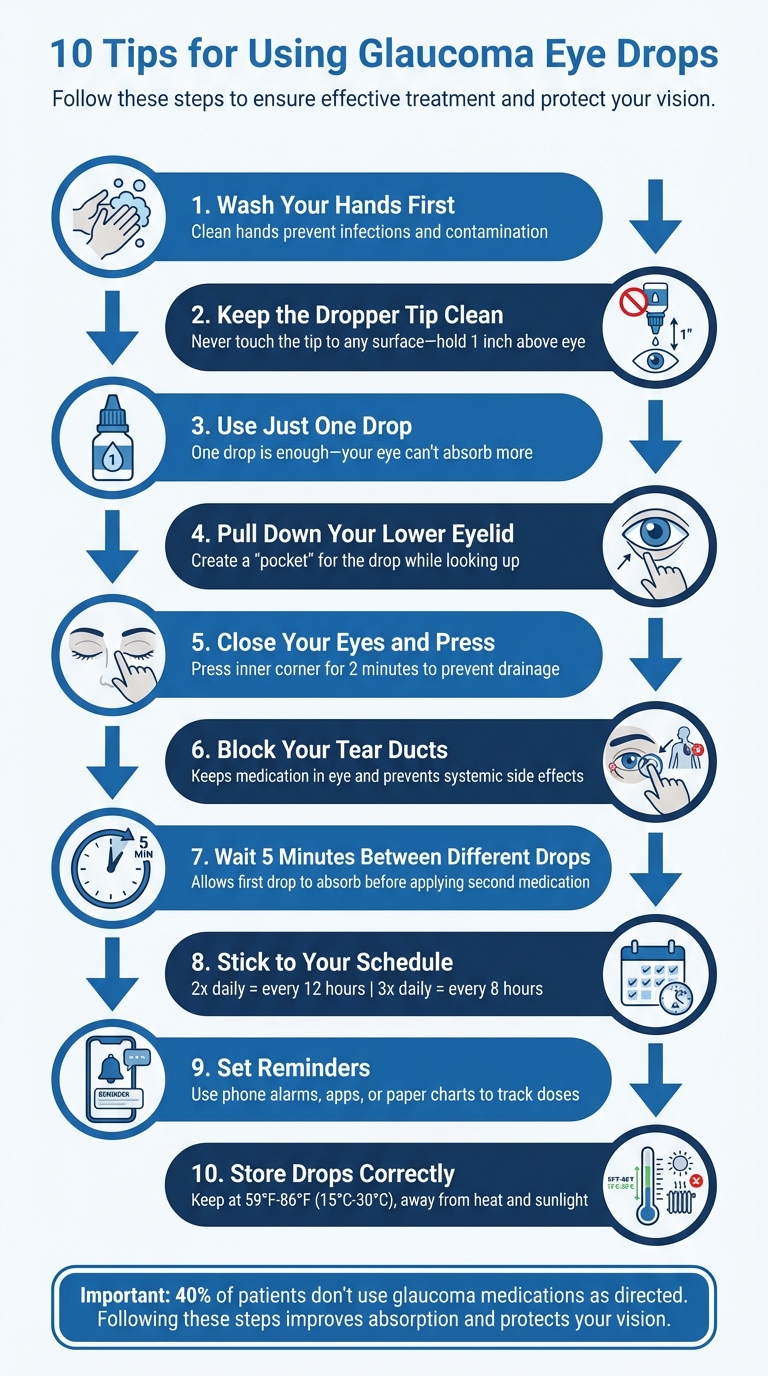
How to Apply Glaucoma Eye Drops Correctly: 10-Step Visual Guide
How to put in your eye drops, for glaucoma patients
sbb-itb-246add9
1. Wash Your Hands First
Keeping your hands clean is crucial when using eye drops. Bacteria from your hands can transfer to your eyes, potentially causing infections that could harm your vision. The National Eye Institute emphasizes this point: "Wash your hands with soap and water before you use eye drops". Clean hands not only protect your eyes but also prevent contamination of the medication.
It’s equally important to keep the dropper tip clean. After washing your hands, avoid touching the tip with your fingers. If it does get contaminated, clean it using a rubbing alcohol pad or a fresh tissue.
For those who rely on caregivers – about 20% of patients, often due to tremors, poor vision, or coordination challenges – both the patient and caregiver should follow strict hand-washing routines.
Finally, when using the eye drops, place the bottle cap on a clean surface, like a fresh tissue, while it’s off. This prevents environmental contaminants from sticking to it. Once you’re done, replace the cap immediately to minimize exposure to airborne particles.
2. Keep the Dropper Tip Clean
It’s crucial to keep the dropper tip of your eye drops clean to avoid contamination. Never let it touch any surface – this includes your eye, eyelid, eyelashes, or even your fingers. As Dr. Bradley L. Schuster, Assistant Clinical Professor at the University of Colorado, explains:
"Be careful not to touch the bottle to your eye as this can transfer bacteria to the bottle tip."
When bacteria make their way back into the bottle, they can lead to infections that might result in serious eye issues.
To maintain the sterility of the dropper, handle it carefully. Hold the bottle about an inch above your eye when applying drops. If you need extra stability, you can brace your hand against your forehead or use your other hand to steady the bottle.
If the dropper tip accidentally touches a surface, it’s important to clean it right away. Dr. Yvonne Ou, Professor of Ophthalmology at the University of California, San Francisco, offers this advice:
"If you do have to clean the bottle tip because of accidental contamination, use a clean tissue or a rubbing alcohol pad."
After cleaning, close the bottle immediately to reduce the risk of further contamination.
3. Use Just One Drop
Stick to just one drop. Your eye can only absorb a small amount of liquid, which means most eye drop bottles dispense more than your eye actually needs. Dr. Yvonne Ou, Professor of Ophthalmology at the University of California, San Francisco, emphasizes:
"A single drop is more than enough for the eye to handle."
If some of the drop trickles down your cheek, don’t worry – it doesn’t mean you’ve missed your dose or need to apply more. The Glaucoma Research Foundation clarifies:
"Most commercially made eye drops deliver a drop that is bigger than the eye can hold. Because of this, it is normal for a small proportion of the drop to roll over onto your cheek."
One drop is all it takes. Adding extra won’t improve effectiveness and will only waste medication, potentially shortening your supply.
4. Pull Down Your Lower Eyelid
Getting the right technique is essential for applying eye drops effectively. Start by using the index finger of your non-dominant hand to gently pull your lower eyelid downward while looking up. This creates a small pocket between your eyelid and eyeball, which is the perfect spot to place the drop. Dr. Yvonne Ou, Professor of Ophthalmology at the University of California, San Francisco, explains:
"With the index finger of your non-dominant hand, gently pull down your lower eyelid to form a ‘pocket.’ Look gently up and squeeze one drop into the pocket in your lower lid using your dominant hand."
The National Eye Institute echoes this advice:
"With 1 hand, pull your lower eyelid down and away from your eyeball – this makes a ‘pocket’ for the drops."
To ensure precision, stabilize your hands. If you experience trembling, try resting the hand holding the bottle against your forehead or your other hand. This helps guide the drop into the pocket rather than missing and hitting your lashes or cheek. Studies show that about 20% of people have difficulty applying eye drops due to shaky hands or coordination issues.
Dr. Ou emphasizes that only drops that land on the eyeball or the inner lower lid are effective. If the drop lands on your skin or lashes, you’ll need to reapply.
5. Close Your Eyes and Press
When managing glaucoma, every step in applying your eye drops matters. Once the drop lands in your eye, gently close your eyelid – no need for excessive blinking or squeezing, as that can cause the medication to drain away. Instead, keep your eyes softly shut and use your index finger to apply light pressure to the inner corner of your eyelid.
This technique, known as punctal occlusion, helps block tear drainage, ensuring the medication stays in your eye where it’s needed. Dr. Yvonne Ou, a Professor of Ophthalmology at the University of California, San Francisco, advises combining both methods for best results:
"The ideal way to instill your eye drops is to combine both methods: close your eyes and press on the inside corners for 2 minutes post-application."
Holding this position for 2 minutes allows the medication to fully absorb and helps reduce intraocular pressure. Many glaucoma specialists emphasize the importance of waiting the full 2 minutes to get the most out of your treatment.
This approach also reduces the chance of systemic side effects by preventing the medication from entering your bloodstream. As glaucoma specialist Dr. Bradley L. Schuster explains:
"The closed eyelids and pressure on the tear drainage duct avoids unwanted systemic side effects from the potent eyedrop drugs by preventing the drop from getting inside the nose where it could enter the bloodstream rapidly."
Taking these extra moments can significantly enhance the effectiveness of your medication while minimizing potential side effects.
6. Block Your Tear Ducts
Blocking your tear ducts, also known as punctal occlusion, helps keep glaucoma medication on the surface of your eye longer, ensuring it’s absorbed properly instead of draining into your nose and throat. This simple action can make a big difference in how well the medication works.
Dr. Yvonne Ou, MD, a Professor of Ophthalmology at the University of California, San Francisco, explains:
"By pressing it closed you prevent the medication from draining away from your eyeball and into your nose."
If the medication drains too quickly, it not only reduces its effectiveness but can also enter your bloodstream through the nasal passages. According to the Wisconsin Council of the Blind & Visually Impaired, this can lead to side effects, including memory loss.
To get the most out of your medication, apply a drop, then gently press the inner corner of your eye with your index finger. Hold it there for 2–3 minutes to keep the medication in place and prevent unwanted drainage.
7. Wait 5 Minutes Between Different Drops
When your glaucoma treatment involves more than one type of eye drop, timing is everything. If you apply the second drop too soon, it might wash away the first, reducing its effectiveness. Giving your eyes a little time ensures each medication does its job properly.
Dr. Yvonne Ou, MD, a Professor of Ophthalmology at the University of California, San Francisco, emphasizes this point:
"Since the first eye drop can wash away the second eye drop if instilled in the eye too quickly, it is recommended to wait 5 minutes between instilling different types of eye drops."
Research backs this up, showing that it takes about 2 minutes for an eye drop to fully penetrate the surface of the eye. Waiting 5 minutes gives your eye ample time to absorb the medication.
Here’s a practical tip: after applying the first drop, use the waiting time to brush your teeth, fix your hair, or get dressed. This way, you’re not just standing around watching the clock. And if your routine includes both drops and ointments, remember to apply the ointment last – it forms a barrier that can block other drops from being absorbed.
8. Stick to Your Schedule
To keep glaucoma in check, consistency with eye drops is non-negotiable. These drops only work when used regularly; skipping doses can disrupt eye pressure control and increase the risk of vision damage. Sticking to a schedule ensures the medication remains effective.
For twice-daily prescriptions, aim to use the drops every 12 hours. If you’re instructed to take them three times a day, space the doses 8 hours apart. This steady timing helps maintain the medication’s effectiveness throughout the day and night. Some medications, like prostaglandin analogues (such as latanoprost, bimatoprost, and travoprost), work best when applied at bedtime.
However, many patients find it challenging to stay consistent. Studies show that around 40% of patients either don’t use their glaucoma medications as directed or stop refilling them altogether. Some even fall into the habit of using drops only before doctor appointments. This inconsistency doesn’t just skew pressure readings – it can also lead to long-term eye damage.
Dr. Gail F. Schwartz, MD, a glaucoma specialist, emphasizes the importance of regularity:
"Prescription eye drops work to prevent glaucoma progression but only if taken on a regular and consistent basis".
To make it easier, tie your eye drops to an everyday habit. For example, use them when brushing your teeth, eating breakfast, or getting ready for bed. Dr. Yvonne Ou, MD, Professor of Ophthalmology at the University of California, San Francisco, offers this advice:
"One effective way to ensure that you take your eye drops is to use them when you are doing another daily activity".
9. Set Reminders
Adding reminders to your routine can be a game-changer when it comes to staying consistent with your glaucoma treatment. Forgetting to use your eye drops is one of the most common reasons treatments don’t work as effectively as they should. And let’s face it – life gets hectic, and even with the best intentions, it’s easy to miss a dose.
Digital alarms are a straightforward solution. You can set recurring alarms on your smartphone to go off at the exact times you need to apply your drops. For medications taken twice a day, schedule alarms 12 hours apart. If you need to use drops three times daily, space the alarms 8 hours apart. These alerts act as a gentle nudge, ensuring you never skip a dose. Beyond alarms, there are also apps designed to help you manage medications. Many free apps let you track multiple prescriptions, check off doses as you take them, and even send notifications if you miss a scheduled time. Wondering, "Did I already use my drops today?" becomes a thing of the past with these tools.
If you’re more of a pen-and-paper person, a simple paper chart can do the trick. Print out a weekly grid, stick it on your bathroom mirror, and mark off each dose as you go. This visual reminder helps prevent double-dosing and gives you peace of mind. For about 20% of patients who need help with their drops due to issues like tremors, poor vision, or coordination challenges, a caregiver or family member can step in to track doses and assist.
Whether you lean toward tech solutions, prefer a low-tech approach, or mix the two, reminders help turn eye drop application into a habit. The key is to choose a system that fits your lifestyle and stick with it. These small steps can make a big difference in keeping your treatment on track.
10. Store Your Drops Correctly
Storing your glaucoma eye drops the right way is key to maintaining their effectiveness and ensuring they work as intended to control eye pressure. Exposure to extreme temperatures can weaken the medication, making it less effective. Dr. Yvonne Ou, a Professor of Ophthalmology at the University of California, San Francisco, emphasizes:
"Avoid keeping your eye drop bottle in your pocket, car, or in direct sunlight where it can get hot".
Most glaucoma medications are best stored at temperatures between 59°F and 86°F (15°C to 30°C).
While refrigeration isn’t necessary for all eye drops, cooling them can help confirm proper application – a cold drop lets you know it made contact. That said, some medications, like Latanoprost, require refrigeration before opening, so always check the label for specific instructions.
It’s also important to replace the cap right after using your drops to prevent contamination. Leaving the bottle open or loosely capped increases the risk of bacterial growth. When applying your drops, place the cap on a clean surface – like a fresh tissue – rather than directly on a countertop.
If you’re traveling, pack your drops in your carry-on bag to keep them at a stable temperature. In particularly hot climates, consider using a cooling pouch to protect them.
Keep an eye on the shelf life of your medication. Most eye drops are only effective for about 28 days after opening, so it’s a good idea to regularly check expiration dates. If your drops have been frozen or exposed to extreme heat, it’s safer to discard and replace them. If you’re unsure about the storage needs of your specific medication, ask your pharmacist – different formulations may require different care.
Get Professional Guidance
While these tips can improve your application technique, there’s no substitute for personalized advice from your eye doctor.
Dr. Yvonne Ou, Professor of Ophthalmology at the University of California, San Francisco, highlights the importance of consulting your doctor:
"It is always a good idea to show your ophthalmologist your eye drop instillation technique. He or she can ensure that you are correctly instilling the medication, as well as offer pointers on your technique."
Demonstrating your method during an appointment allows your doctor to make sure you’re applying the drops correctly. It’s also a great opportunity to bring your eye drop bottles so they can review the dosages and schedules with you. This is especially helpful if you’re managing multiple medications or using over-the-counter products like artificial tears.
If you notice any side effects, such as irritation or unexpected changes in your health, let your ophthalmologist know right away. For those struggling with the application process, your doctor can suggest assistive tools or even discuss alternative treatments, such as laser procedures, to simplify your routine.
Cheyenne Eye Clinic and Surgery Center offers a full range of glaucoma care and can provide the tailored support you need to manage your treatment effectively. Their team can evaluate your technique, recommend tools to address physical challenges, and work with you to create a treatment plan that aligns with your daily life. Consider scheduling an appointment with Cheyenne Eye Clinic and Surgery Center to refine your glaucoma management and ensure you’re on the right track.
Conclusion
Managing glaucoma effectively requires paying close attention to technique, maintaining a consistent schedule, and storing medications properly. These simple steps can significantly improve how well your eye drops work and help safeguard your vision.
The National Eye Institute puts it plainly:
"Remember, eye drops for diseases like glaucoma can prevent your vision from getting worse. If you don’t use them correctly, you could lose your vision."
Missing doses is one of the most common reasons glaucoma treatments fail. To stay on track, consider setting reminders, pairing your eye drop routine with daily habits like brushing your teeth, or keeping a dose-tracking chart. These small adjustments can go a long way in ensuring your treatment remains effective.
If you’re dealing with challenges like burning, stinging, or trouble applying your drops, don’t hesitate to seek help. Your ophthalmologist might recommend preservative-free formulations, tools to assist with application, or even alternative treatments. Bringing your eye drop bottles to appointments is also a great idea – it allows your doctor to confirm you’re using the correct medications and following the right schedule.
FAQs
What’s the best way to use glaucoma eye drops effectively?
To make sure your glaucoma eye drops work as they should, start by washing your hands thoroughly – this helps prevent any chance of infection. Then, tilt your head back or lie down, gently pull down your lower eyelid to form a small pocket, and carefully squeeze one drop into this space. Be cautious not to let the dropper touch your eye or skin to keep it clean. After applying the drop, close your eye gently and press lightly on the inner corner (near the tear duct) for about two minutes. This helps the medication absorb properly and minimizes drainage.
If you’re using more than one type of eye drop, give it a little time – wait at least 2–5 minutes between applications. This prevents the first dose from being washed away. Also, make sure to store your eye drops correctly: keep the bottle tightly closed and away from heat or direct sunlight to preserve their effectiveness. By following these steps, you can ensure your treatment works as intended and supports your vision health.
What should I do if my glaucoma eye drops cause side effects?
If you experience any side effects from your glaucoma eye drops, reach out to your eye doctor promptly. They’ll assess whether changes to your medication or dosage are necessary.
It’s important not to stop using your prescribed eye drops without consulting your doctor first, as this could make your condition worse. Take note of any symptoms you encounter so you can discuss them during your appointment.
What’s the best way to use glaucoma eye drops as part of my daily routine?
To use glaucoma eye drops effectively and seamlessly incorporate them into your routine, begin by washing your hands thoroughly to minimize the risk of infection. Once your hands are clean, tilt your head back, look upward, and gently pull down your lower eyelid to create a small pocket. Hold the eye drop bottle about 1–2 inches above your eye, making sure the tip doesn’t touch your eye or eyelid, and carefully squeeze one drop into the pocket.
After applying the drop, close your eye gently and use your fingertip to press lightly on the inner corner of your eyelid (near the tear duct) for 1–2 minutes. This simple step helps the medication absorb properly and prevents it from draining into your nasal passages. If you need to use more than one type of eye drop, wait at least 5 minutes between applications to ensure each medication works as intended.
By sticking to these steps, you’ll get the most out of your treatment while minimizing contamination and potential side effects.