
Before I agree to LASIK, I want clear answers about my eligibility, likely vision, risks, recovery, and total cost. LASIK may reduce my need for glasses, but it does not guarantee 20/20 vision – or prevent the need for reading glasses.
Here’s what I’d ask before deciding:
- Am I a good candidate? How do my prescription, corneal scans, dry eye, health history, and medications affect my options?
- Why LASIK? Would LASIK vs PRK, glasses, or contacts be safer for my eyes and daily needs?
- What results can I expect? Could I still need glasses or have lasting dryness, glare, halos, or vision loss?
- Who handles my care? What experience does my surgeon have with this laser, and who manages follow-up visits and complications?
- What does recovery involve? When can I drive, work, and exercise – and whom do I call for urgent symptoms?
- What will I pay? Typical U.S. prices run $2,000–$3,000 per eye. I’d request written details on testing, follow-up care, further treatment, and refunds.
My rule: <u>get answers before signing consent</u>. I’d bring my medication list, eye history, and vision goals – and take time to review the plan. There’s no need to decide during the consultation.
Ask These 3 Qs Before Choosing a LASIK Surgeon
sbb-itb-246add9
Am I a Good Candidate for LASIK?
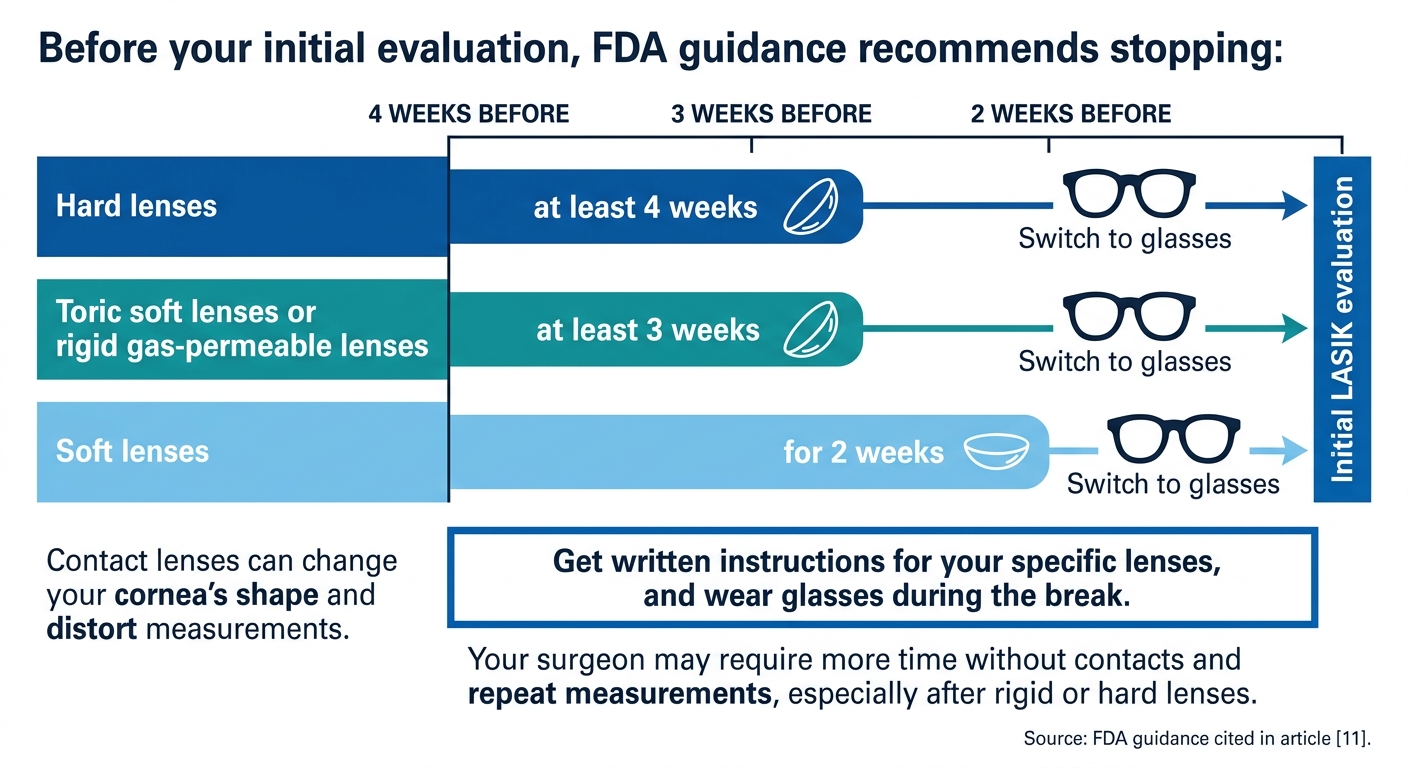
When to Stop Contacts Before a LASIK Evaluation
A LASIK evaluation checks more than your vision. It includes refraction, tear-film testing, eye pressure measurement, corneal scans, and a dilated exam to check for issues that could affect surgery. These results help your surgeon decide whether LASIK is safe for you, whether the results are predictable, and whether to proceed or wait. Use the questions below to understand whether an issue is temporary, treatable, or rules out LASIK.
Is My Prescription Stable, and Are My Corneas Suitable?
Ask how much your prescription has changed over the past 12 months. FDA patient materials commonly use a change of no more than 0.50 diopters as evidence of stability, though requirements vary by laser. Your prescription must also fall within the proposed laser’s approved range.
Your cornea’s thickness and shape matter as much as your prescription. Pachymetry measures thickness, while topography or tomography maps the cornea and checks for irregularities, including signs of keratoconus. Ask how much tissue treatment would remove and whether enough healthy cornea would remain.
Could My Health History Affect My Eligibility?
Tell your surgeon about dry eye, keratoconus, corneal scarring, glaucoma, cataracts, retinal disease, and any past eye injury, infection, or surgery. Also share whether you have diabetes or autoimmune disease, are pregnant or breastfeeding, or take medications. Some findings call for treatment or repeat testing before surgery; others rule out LASIK.
Accurate measurements depend on the condition of your eyes on testing day. That includes changes caused by contact lenses.
When Should I Stop Wearing Contacts Before Testing?
Contact lenses can change your cornea’s shape and distort measurements. Before your initial evaluation, FDA guidance recommends stopping:
- Soft lenses for 2 weeks
- Toric soft lenses or rigid gas-permeable lenses for at least 3 weeks
- Hard lenses for at least 4 weeks
Get written instructions for your specific lenses, and wear glasses during the break. Your surgeon may require more time without contacts and repeat measurements, especially after rigid or hard lenses.
Why Do You Recommend LASIK for Me?
Ask your surgeon how your exam results, work, hobbies, night driving, and vision goals make LASIK a better fit than other options. Request a direct comparison of LASIK, PRK, and nonsurgical correction based on your eyes and daily needs.
| Option | Potential benefits | Limitations and eligibility |
|---|---|---|
| LASIK | Fast recovery; treatment tailored to your prescription and corneal measurements. | Requires adequate corneal thickness and shape; risks include dry eye, visual disturbances, and flap complications. |
| PRK | No corneal flap; may suit people whose corneal thickness, shape, or contact-sport exposure makes LASIK less suitable. | Slower, more uncomfortable recovery; requires a treatable prescription and a healthy cornea. |
| Glasses or contacts | Avoid surgical risk; can be adjusted as your prescription changes. | Glasses may get in the way during sports or work; contacts require hygiene and may worsen dryness. |
Would Another Procedure or Glasses Be Safer?
Ask your surgeon to explain which exam findings make one option safer or more predictable than another. You can ask:
“Do my corneal thickness, shape, tear film, prescription, or eye health make PRK or glasses safer?”
Discuss whether prescription changes, severe dry eye, or eye disease make nonsurgical correction a better choice.
How Does My Prescription Shape the Treatment Plan?
Ask how your nearsightedness, farsightedness, astigmatism, and other optical imperfections affect the correction you can expect – and whether custom planning makes sense for you. Request results for patients with prescriptions like yours, including how often they still need glasses.
If some prescription remains or returns later, a follow-up procedure may not be possible. Further surgery requires enough remaining corneal tissue, stable measurements, and healthy eyes.
Should I Consider Monovision for Presbyopia?
LASIK does not prevent presbyopia, the age-related loss of near-focusing ability. Even with clear distance vision, you may need reading glasses. Monovision leaves one eye focused mainly for distance and the other for near work. Ask whether less reliance on reading glasses is worth the tradeoff in depth perception and visual quality.
A contact-lens monovision trial may help you test reading, computer work, and distance vision before permanent treatment. Ask whether a trial would suit you. Discuss your night-driving and work needs, including whether you would still need glasses for tasks that require sharp vision.
Once you know which procedure fits you, ask what results and side effects you can realistically expect.
What Results and Risks Should I Expect?
Once you’ve discussed whether LASIK fits your eyes, ask what results and side effects you can expect based on your exam.
LASIK may reduce your need for glasses, but it doesn’t guarantee 20/20 vision or freedom from glasses. Ask how well you’re likely to see in daily life – not just on an eye chart. Glare and trouble driving at night can remain.
| Question to ask | Why it matters |
|---|---|
| What vision should I expect in each eye, and will I still need glasses? | Ask what percentage of patients with eyes like yours reach 20/20, 20/25, or 20/40 in each eye, and how long they were followed. You may still need glasses for night driving or some close-up tasks. |
| Could dry eye or fluctuating blur persist? | Dry eye can cause discomfort and vision that blurs or changes throughout the day. It can sometimes be severe or persistent. Ask how your tear-film findings affect your risk and treatment options. |
| Could glare, halos, or starbursts affect my night driving? | These symptoms, along with reduced contrast, can make it harder to see in low light – even with good eye-chart results. |
| How often do undercorrection, overcorrection, or regression occur? | Treatment may fall short of the target, go beyond it, or lose some effect over time. Ask how often this happens in patients with a prescription like yours. |
| If I need further treatment, when could it happen? | Ask about the minimum waiting period and which healing milestones you must meet first. A second procedure may not be safe or possible. |
| What are your rates of flap complications and infection? | These problems may need urgent treatment or another procedure. Ask how the team spots and treats them. |
| Could my vision be permanently worse? | Rare complications can leave your vision worse even with glasses or contacts. Ask specifically about vision loss despite glasses or contacts, corneal scarring, and corneal ectasia (weakening and bulging of the cornea). |
Ask for the surgeon’s own results with the proposed laser, including the number of eyes studied. Your prescription, corneal measurements, tear-film health, age, and healing response can make your risks different from the average.
Find out which symptoms need an urgent call and whom to contact after hours. Sudden blur, pain, or light sensitivity should prompt a call to the surgical team rather than waiting for your next scheduled visit.
Next, ask who will perform the surgery and manage your follow-up care.
How Qualified and Experienced Is My Surgeon?
Once you’ve reviewed the results and risks, confirm who will perform your surgery and check their qualifications.
What Is Your Experience With This Procedure and Laser?
Ask whether your surgeon is a board-certified ophthalmologist with training in refractive surgery. Verify their license, board status, and disciplinary history through the appropriate medical board. Credentials alone don’t guarantee results.
Ask how many LASIK procedures they’ve performed, how many they’ve done with this laser, and how often they use it now. Find out how much experience they have with prescriptions and corneal measurements like yours. Confirm which physician will actually perform your surgery.
Request the laser’s manufacturer and model, along with its patient guide, before you consent. Ask whether your age, prescription, and treatment plan fall within the laser’s FDA-approved indications. FDA approval covers specific uses; it doesn’t guarantee your outcome.
Then ask how the rest of the care team will handle testing and follow-up.
Who Handles Testing, Follow-Up, and Complications?
Ask who takes measurements, reviews scans, decides whether you’re a candidate, and performs follow-up exams. If several clinicians share your care, clarify each person’s role, who will answer your concerns, and how they’ll share your records.
If an optometrist handles routine follow-up, ask how concerns get to the surgeon. Also confirm who manages persistent symptoms and evaluates whether you need further treatment.
What Should I Expect During Surgery and Recovery?
Once you know who will handle your follow-up care, ask what to expect on surgery day and during recovery.
How Should I Prepare for Surgery?
Ask how long the visit will take, how your eyes may feel during the first few hours, and whether you should rest or nap afterward. Temporary scratchiness, tearing, burning, and blurry vision can last several hours. Arrange a ride home, and check whether you’ll need help that evening or rides to follow-up visits.
Get written instructions for using your prescribed eye drops and avoiding eye makeup, lotions, or creams. Ask whether you’ll need a protective eye shield while sleeping. Don’t stop any medication unless your surgeon tells you to.
When Can I Drive, Work, and Exercise?
Ask for a recovery schedule that fits your job and daily routine. Confirm when you can drive, return to screen work, exercise, swim, use hot tubs, and play contact sports. Also ask how long you must avoid rubbing your eyes.
Discuss whether night glare or changes in vision could affect driving. If you work in a dusty setting, ask what precautions to take and whether you’ll need protective eyewear.
What Follow-Up Care and Emergency Instructions Will I Get?
Schedule your first follow-up before you leave. FDA guidance calls for an exam within 24–48 hours and follow-up care for at least six months. Confirm when your surgeon will reassess persistent dryness, glare, halos, or fluctuating vision, and ask which treatments may help.
Get written emergency instructions and an after-hours phone number. Make sure you know where to go if the clinic is closed. Contact the surgical team immediately for severe or increasing pain, sudden vision changes or worsening vision, redness, discharge, or increasing light sensitivity. Don’t wait for your next scheduled visit.
What Does the Total Price Include?
Once you understand your likely results and recovery, get the full cost in writing before scheduling. Request an itemized estimate in U.S. dollars, and confirm whether it covers one eye or both. Don’t rely on a promotional price. Typical U.S. LASIK prices are about $2,000–$3,000 per eye, or $4,000–$6,000 for both eyes.
Ask whether the estimate covers the consultation, diagnostic testing, surgeon’s fees, facility fees, laser and technology charges, medications, and supplies. Also check what you’ll owe if you’re not a candidate, choose not to proceed, or need repeat testing.
Get follow-up terms in writing, too. Confirm how many visits are included, when coverage ends, and what additional visits cost. Ask about charges for dry-eye treatment, urgent visits, and complications. If the price includes an enhancement – a follow-up procedure to adjust your vision – check its time limit, medical eligibility rules, and any separate testing or facility fees. Enhancement coverage doesn’t guarantee you’ll qualify for retreatment.
Most medical insurance doesn’t cover elective LASIK. Check coverage, vision-plan discounts, and HSA or FSA eligibility with the practice and your insurer or plan administrator. If you’re financing the procedure, request the APR, down payment, loan term, fees, interest start date, and total repayment amount – not just the monthly payment.
Before paying a deposit, confirm the cancellation, rescheduling, and refund rules. Ask whether consultation, surgical, or facility deposits and financing fees are refundable. Keep affordability separate from medical suitability: financing or a discount shouldn’t determine whether LASIK is right for your eyes. Use the written estimate as you review the practice’s answers and make your decision.
Review the Answers Before You Decide
Review the surgeon’s answers together before making a decision. Decide only after a complete eye examination. Before agreeing to surgery, go over the exam findings, expected vision, key risks, recovery limits, follow-up plan, and total cost.
Take the consent forms and patient booklet home. The FDA advises reading these materials and asking questions until you understand the risks and benefits before agreeing to surgery. You should be able to explain the benefits, limits, and chance of needing glasses in your own words. You don’t need to decide during the consultation.
What Should I Bring to My Consultation?
Bring the materials you’ll need to check the answers you receive.
Pack your current glasses, contact lens prescription, lens type, usual wearing schedule, and the date you last wore contacts. Ask the clinic when to stop wearing contacts before testing. Contacts can temporarily change the shape of your cornea.
Include a list of medications, supplements, and allergies, along with your medical and eye history and records of past eye procedures. Write down your vision goals for activities such as reading, computer work, sports, or night driving.
Bring written questions and leave space to record answers. If something isn’t clear, ask how your measurements affect your eligibility or request a written recovery timeline. Get answers to every question before surgery.